Disclosure: This article contains affiliate links. If you buy through them we may earn a small commission at no extra cost to you. We only recommend gear that meets current reptile care guidelines. See our affiliate disclosure.
Short answer: For most bearded dragon setups, the best UVB light is a linear T5 HO tube, either the Arcadia D3+ Desert 12% or the Zoo Med ReptiSun T5 HO 10.0. Get one roughly half to two-thirds the length of the enclosure, mount it inside a reflector next to the basking lamp, and set it at a height that gives a UV Index of about 4–6 at the basking spot. Skip compact “coil” bulbs.
Why UVB isn’t optional
Bearded dragons make vitamin D3 in their skin when they’re exposed to UVB (290–315 nm) wavelengths. Without D3 they can’t absorb dietary calcium, and that leads to metabolic bone disease (MBD), the condition vets see most in pet dragons. Oral D3 in supplements helps but isn’t a full replacement. UVB also affects appetite, activity and behaviour. Our health guide covers the signs of MBD.
Light passing through window glass or most plastics loses nearly all its UVB, so sunlight through a window doesn’t count.
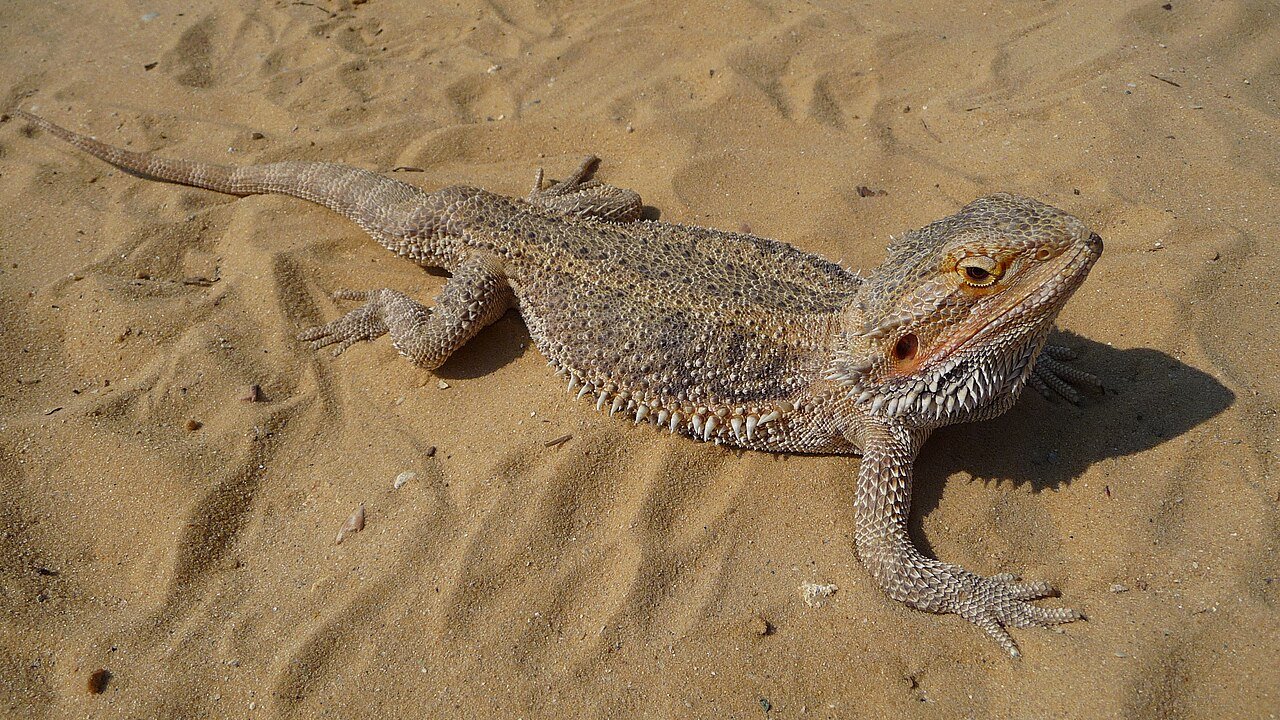
How much UVB does a bearded dragon need?
The standard reference is the Ferguson zone system (Ferguson et al., 2010; Baines et al., 2016, Journal of Zoo and Aquarium Research). Bearded dragons are Zone 3–4 open-habitat baskers. In practice that means:
- UVI 4–6 at the dragon’s back while it sits on the basking spot. Some keepers go up to about 7 with high-output setups.
- A gradient down to UVI 0–1 in shaded areas and hides, so the dragon can control its exposure.
- Run it 12–14 hours a day on the same timer as the heat lamp.
The only way to know your number is to measure. A Solarmeter 6.5 UV Index meter costs more than a bulb but lasts for years. It shows you when a tube has decayed instead of leaving you to guess. Check Solarmeter 6.5 UV Index meter on Amazon
Our top picks
1. Arcadia D3+ Desert 12% T5 HO (best overall)
This is the UK and EU standard, and widely sold in the US. It has a strong output with a good spread along the tube, and Arcadia publishes UVI-by-distance charts. Over a mesh screen top it typically reaches UVI 4–6 at about 30–38 cm (12–15 in) basking distance. Mounted inside the enclosure, you need more distance than that. Rated life is about 12 months. Check Arcadia ProT5 Desert 12% kit on Amazon
2. Zoo Med ReptiSun T5 HO 10.0 (best US availability)
This one is very close in performance, cheaper and easier to find in US stores. Use it with Zoo Med’s reflector fixture, since a bare tube wastes much of its output. Check Zoo Med ReptiSun T5 HO hood with 10.0 bulb on Amazon
3. Mercury vapour bulbs (for tall enclosures)
Self-ballasted mercury vapour lamps (look for “MVB,” such as Mega-Ray or Zoo Med PowerSun) give UVB and heat from a single bulb. They can work well in very tall or open-top enclosures. Their output varies a lot from bulb to bulb, they can’t go on a dimming thermostat, and they need an inch-perfect distance, so measure with a meter. Check Mega-Ray 100W mercury vapor bulb on Amazon
What to avoid
- Compact and coil UVB bulbs. These give a small, intense hotspot and a poor gradient, and older batches were linked to eye problems (photo-kerato-conjunctivitis).
- Old-style T8 tubes such as the ReptiSun 10.0 T8. They’re too weak for a 4×2 ft enclosure at normal distances, unless they’re mounted very close inside.
- “Full spectrum” household LEDs. They give no meaningful UVB.
- Glass or acrylic between bulb and dragon. These block UVB.
Getting distance and mesh right
A screen top or mesh guard typically cuts UVB by 30–50%, depending on how fine the mesh is. So a bulb that gives UVI 6 at 30 cm bare might give 3–4 through mesh. That’s why mesh-mounted setups use the stronger 12% tubes. Mount the tube alongside the basking lamp so heat and UV overlap at the same spot, as sunlight does. Then:
- Set your basking platform height so the dragon’s back sits at the bulb maker’s recommended distance.
- Measure UVI at the dragon’s back position.
- Adjust platform height, not the bulb, until you read 4–6.
- Check that the cool end reads near 0–1.
See our habitat setup guide for the full lighting and heat layout, and the tank size guide for choosing tube length.
Tube length by enclosure
| Enclosure | Recommended T5 HO length |
|---|---|
| 4×2×2 ft (120 gal) | 22–24 in (some keepers use 34 in) |
| 5×2.5×2 ft | 34 in |
| 6×2×2 ft | 34–46 in |
When to replace your UVB
UVB output fades long before the visible light does. Replace T5 HO tubes every 12 months (Arcadia rates some for longer), T8s every 6 months, and MVBs when the meter says so. Write the install date on the fixture. With a Solarmeter, replace when the basking UVI drops below your target.
Common UVB mistakes we see
- Tube on the wrong side. If the UVB sits over the cool end and the heat lamp over the warm end, the dragon has to choose between heat and UV. Keep them side by side.
- No reflector. A bare T5 tube sends much of its output up and sideways, and a reflector can nearly double the usable UVB below it.
- Basking platform too high. Adding a tall rock can put the dragon’s back 15 cm from a 12% tube inside the enclosure, which may exceed UVI 8. Measure after any change.
- Forgetting to replace it. A three-year-old tube can still glow brightly and produce almost no UVB.
- Relying on D3 supplements instead. Supplements help, but over-supplementing D3 can be toxic, and they don’t replace the behavioural benefits of proper light.
Complete lighting kit (what to buy)
- T5 HO 12% or 10.0 tube and a reflector fixture. Check Arcadia ProT5 Desert 12% kit on Amazon
- Halogen flood bulbs, 50–100 W depending on height. Check halogen PAR38 flood bulb on Amazon
- Ceramic dome fixture for the halogen.
- Dimming thermostat for the halogen.
- Digital timer for all the lights.
- UV Index meter (Solarmeter 6.5).
- Infrared temperature gun.
Using the kit in a smaller or older setup? Read the tank size guide. A 4×2×2 ft space is what makes a proper heat and UV gradient possible.
FAQ
Do bearded dragons need UVB at night?
No. Turn all lights off at night. A natural temperature drop to about 18–24 °C (65–75 °F) is healthy.
Can I use a UVB bulb and a heat lamp together?
Yes, and you should. The UVB tube gives UV and some visible light, and a halogen flood bulb gives the basking heat (about 40–43 °C, 104–110 °F, surface temperature for adults).
Is natural sunlight better?
Unfiltered outdoor sun is excellent, but only in a secure, shaded enclosure under supervision. Dragons overheat fast in a glass tank in the sun.
How do I know if my dragon is getting too much UVB?
Watch for squinting, keeping its eyes closed in the light, or hiding all the time. Measure, and raise the platform or add mesh if the UVI is above about 7.
Are T5 UVB bulbs safe for babies?
Yes. Juveniles need UVB most of all while their bones grow, as long as there’s a proper gradient and shade.
Sources: Baines F. et al. (2016) “How much UV-B does my reptile need? The UV-Tool,” J. Zoo Aquar. Res.; Ferguson G.W. et al. (2010) Zoo Biology; Arcadia Reptile distance charts; ARAV. General information, not veterinary advice.
This guide is part of our bearded dragon care guides hub.
Related: Best heat lamp for bearded dragons.